| |
Market
Trends
The Information and Internet Revolution
has changed the way that consumers and businesses communicate
within themselves and their external partners. We now have
many choices in which we may exchange information: email,
fax, voice-mail, and video mail all on a wide array of multimedia
devices; wireless phones, personal computers, fax machines
and PDA's. The integration of this information with the communication
devices that port it has lead has simplified communications
on a global scale. The ability to send and receive conversations
and information via the Internet is the beginning of the Voice-over
IP market.
"In early 2000, IP telephony was the
latest technology set to challenge established models of voice
service provision. It opened up new opportunities for competitive
carriers and gave incumbents a way to break free from paying
high prices for circuit-switched voice equipment. However,
we are now in the era of declining technology stocks, financial
difficulties.
Softswitches are the key to helping established
carriers rebuild their businesses and helping new-entrant
carriers enter the market. They will deliver cost savings
and enable a far greater range of services that can be delivered
from the rigid voice switching platforms deployed today"
- Ovum Report (Softswitches: The keys to next-generation IP
network opportunity)
|
|
Market Trends
"On the business front, deregulation of
telecommuni-cations is opening up the world as a market anyone
can play in. We are becoming an increasingly mobile society
hungry for integrated services. All that is needed is the glue
to hold it all together; intelligence that allows applications
to run seamlessly over divergent access and transport networks.
That is the role of the softswitch"
Telecom Technologies, Inc
"The Environment for Convergence".
|
| |
Overview
ILT's Softswitch is an Application-enabled
Softswitch. This is a generation of Softswitches that brings
about a revolutionary shift in the market by being application-centric
versus telephony-centric.
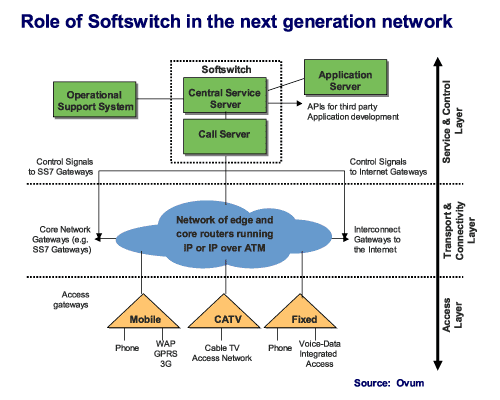
CINC architecture allows advanced applications
to be quickly introduced and also provides a natural mechanism
for interfacing with other hosted applications, both within
a service provider's network and the Internet. Such service
applications give service providers compelling reasons for
deploying softswitches, enabling them to move from declining
business models such as selling simple cost-effective basic
services for less, to significant revenue generating new services.
These applications offer a model of hosted services similar
to what made Centrix initially popular, but focus on advanced
PBX functions and other new innovative services not typically
provided by traditional telephony companies. Examples are
click-to-dial, voice-activated dialing, and answering e-mail
from the phone. Furthermore, such services can be provisioned
and managed from the web.
CINC identifies and deciphers telephony
data such as voice, fax, modem data and video in real-time
over PSTN lines or any channels capable of carrying data.
Such a system would dynamically identify the type of data;
voice, fax, modem data or video and execute appropriate routines
to process and route the data.
Universal
Port
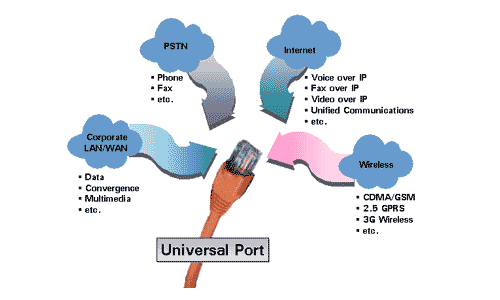
Universal port enables equipment providers
to overcome the shortcomings of traditional systems to meet
the demanding requirements of ISPs, telecom carriers, and
Internet telephony service providers (ITSPs). Universal port-enabled
IT equipment will support voice, fax, and modem services over
packet-switched networks such as Ethernet LANs, asynchronous
transfer mode (ATM) backbones, and frame-relay wide-area networks
(WANs).
When bundled into an "AECOS" system,
ILT's e-business platform, CINC provides all the functionality
required of a PSTN-interface device for inbound and outbound
calls. On its own, it can serve as a media gateway able to
accept and route Voice-over-IP (VoIP) and real- time Fax-over-IP
(FoIP) calls.
top
|