Overview
ILT's Application-Enabled Softswitch, Convergent
Inter-Networking Controller (CINC) is a multi-purpose gateway
and telephony server. It enables easy access to information
via the telephone similar to an Internet information portal.
CINC features "Universal Port" technology, a gateway capable
of automatically detecting and handling voice, fax and data
traffic. CINC makes "One Number-One Place" a reality.
When bundled with ILT's e-business "AECOS"
platform, CINC functions as a PSTN-interface device processing
inbound and outbound calls. From this platform ILT is able
to create next generation applications like our Web Based
Call Center. CINC's stand-alone versatility enables it to
serve as a media gateway capable of accepting and routing
both Voice-over-IP (VoIP) and real-time Fax-over-IP (FoIP)
calls.
CINC's unique advantage is reflected
in its flexible scalability, its design permits it to function
from a single T1/E1 up to more than 14 T1/E1 ports, over a
wide range of different requirements. Operational features
like advanced calling features, text-to-speech, voice recognition,
etc. can be configured in or out of the hardware or software
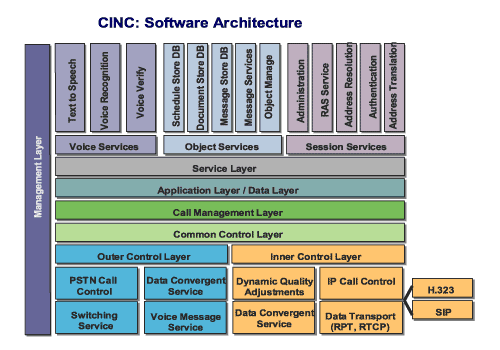
architecture. Because ILT's design is based on a client-server
model, our advanced features like text-to-speech and voice
recognition can be distributed over a variety of servers for
load balancing. CINC's next release will incorporate Voice
XML (VXML) allowing rapid development of new applications
similar to the web paradigm.
Voice over Internet Protocol
(VoIP)
CINC can be a media gateway providing VoIP
and real-time FoIP calls, thus giving consumers a dial-tone
experience virtually indistinguishable from the PSTN service.
CINC supports VoIP, allowing consumers to make calls PC-to-Phone,
Phone-to-PC and Phone-to-Phone. CINC supports H.323 standards
and are moving towards H.248 (Megaco) and SIP (Session Initiation
Protocol). CINC also incorporates Dynamic jitter buffer management
to keep the voice quality at its optimal level.
Fax over Internet Protocol
(FoIP)
CINC supports real-time fax according
to the ITU T.38 standard (under the umbrella of the H.323
standard). T.38 is an encoding format parallel to voice coders
like G.723 and G.711. CINC supports Store-and-Forward fax
empowering customers with more document management options:
they can elect to have faxes sent at selected times, save
faxes to files, view them from the web, or they can originate
faxes from both the PC and the web. CINC also offers multimedia
conversion that converts PDF and MS Office files into fax
compatible TIF files.
Unified Communication
CINC's supremacy is highlighted when it
is bundled together with other CINC options like Universal
Messaging or advanced calling features. CINC's ability to
automatically distinguish between incoming voice or fax calls
sets it apart from all other media gateways and advanced calling
management systems. Consumers can access their inbox with
almost the same convenience and functionality as the web.
They can navigate through the IVR menus by giving voice commands
that re processed with the help of a versatile automated speech
recognition (ASR) engine. They can listen to their email or
faxes using a powerful text-to-speech (TTS) system. Further,
they can manipulate messages in many ways (listen, delete,
forward, reply). Subscribers from an address book can be recognized
by their names, instead of by phone, fax number or by email
address. This application also allows for consumers to listen
to their daily schedules.
Advanced-Calling
Features
These features show the power of IP-based
communication. CINC supports a variety of advanced calling
features, including:
- Call Forwarding
- Call Filtering
- Call Screening
- Call Waiting
- Call Hold
- Call Transfer
- Three Way Calling
- Last Number Redial
- Caller ID
- Personal Mobility
CINC Benefits
- Carrier-grade performance and toll
quality
- Access device for UMS, AECOS/UCS,
and VoIP/FoIP
- Universal ports
- Fax capture into files
- Store-and-forward Fax over IP
- Real-time Fax over IP
- Advanced signaling protocols with
PRI-ISDN support
- Worldwide T1/E1 connectivity
- Up to 14 T1/E1 spans per cPCI box
- Secure communication through RAS
- Scalable and stackable
- CDR management
- H.323 compliant
- Netmeeting compliant
top
| go back to list
|